
The History of Virtual Reality: From the 1950s to Today
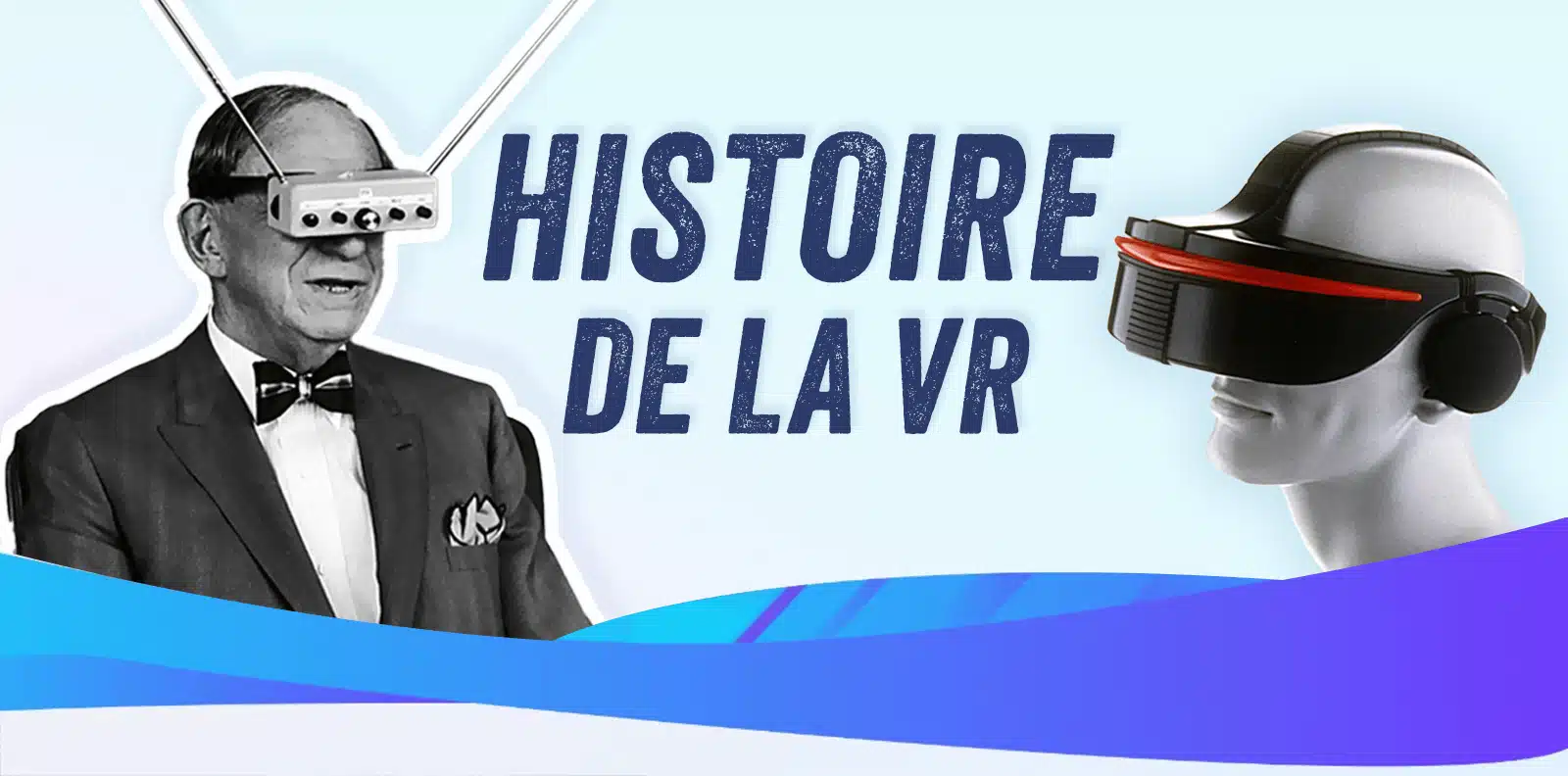
Virtual reality (VR) is a technology that immerses users in a simulated 3D environment. Contrary to what one might think, its origins date back over 60 years. VR is the result of the perseverance of bold visionaries who believed in their inventions and pushed the boundaries of what we thought possible at the time.
Discover the history of virtual reality and how this revolutionary technology has evolved from the 1950s to today.
Timeline of Key Dates in Virtual Reality
The history of virtual reality (VR), a bridge between our physical world and digital universes, goes back much further than many imagine, with key developments spanning several decades.
The Pioneers of Virtual Reality (1950-1970)
####Morton Heilig's Sensorama (1957): It was in 1957 that filmmaker Morton Heilig invented the "Sensorama," a machine designed to immerse users in an imaginary world, offering a new cinematic experience. Later in 1960, he filed a patent for his idea.
Ivan Sutherland's Sword of Damocles (1968):
In 1968, Ivan Sutherland created the Sword of Damocles, considered the first functional VR headset. The "headset" was too heavy to be commercialized, but it could display simple shapes that changed perspective based on the user's head movements.
####Thomas Furness's "Super Cockpit" (1970): In 1970, military engineer Thomas Furness developed the "Super Cockpit," an immersive flight simulator for the military. This project, which spanned over 10 years, resulted in a training cockpit capable of projecting computer-generated 3D maps and real-time data. It was therefore the first virtual reality flight simulator!
The Era of Concepts and VR Prototypes (1970-1990)
In 1973, Myron Krueger coined the term "artificial reality."
In 1978, the ancestor of Google Earth VR was born. Developed by MIT and DARPA (Defense Advanced Research Projects Agency), Aspen Movie Map allowed users to visit the city as if they were there. This invention marks the beginnings of the interactivity offered by VR.
In 1991, the first virtual reality headset dedicated to gaming was born: The Sega VR. However, the project was never commercialized for fear of failure.
The VR Revolution (2000-2015)
From 2010 to 2012, the democratization of virtual reality began! It started with the emergence of the Oculus Rift, created by Palmer Luckey.
- In 2014, Facebook (now Meta) acquired Oculus, marking the entry of tech giants into the VR domain.
The Democratization of Virtual Reality (2016-2019)
In 2016, the first commercial version of the Oculus Rift was launched, an important step toward making VR accessible to the general public.
In 2017, VR became embedded in society with numerous companies developing their own headsets. We also saw the emergence of practical applications, such as first aid training in VR (SST VR).
In 2019, the Oculus Quest was born, a standalone wireless headset that revolutionized the VR experience by making it more accessible and comfortable. 2020 marked the arrival of SST VR and FIRE VR with standalone headsets!
Recent Innovations and Current Trends in Virtual Reality (2020-2024)
In 2020, the Meta Quest 2 (formerly Oculus Quest 2) was launched. In the first quarter of 2021, Meta shipped over 4.6 million headsets, demonstrating the enthusiasm around virtual reality.
In 2023, the Meta Quest 3 succeeded the Meta Quest 2. It merges virtual reality and augmented reality and introduces the term mixed reality. To learn about the differences between Meta Quest 2 and Meta Quest 3, we invite you to read our article.
In 2024, the Apple Vision Pro was released, a mixed reality headset that integrates iOS to access Apple services in virtual spaces.

The Future of Virtual Reality
The history of virtual reality is a fascinating testament to human capability. Today, virtual reality continues to evolve and find new applications across various fields, from education to entertainment, including professional training and scientific research.
The same goes for augmented reality, which is becoming a learning tool for training learners in fire safety procedures! To learn more about our virtual and augmented reality training: FIRE AR and VR at IKEA
IRWINO places innovation at the heart of its priorities and sees in virtual reality the future of training. If these are also your beliefs, don't hesitate to contact us for more information.
Learn more about IRWINO training modules
In a professional environment of over 200 m², including a kitchen, offices, and a meeting room, you can choose from more than 18 different scenarios.
In a professional environment of over 200 m², including workshops, offices, and a storage area, you can choose from more than 18 different scenarios.
In a hospital environment comprising 8 rooms, a break room, a kitchenette, and safety areas, respond to fire outbreaks, manage fire alarm system alerts, and evacuate patients.
Evacuation of a victim from a burning room
The victim is choking
Care of a symptomatic person
The victim is having a fainting spell
The victim has been burned
The victim has been burned
Assault victim with open wound
The victim is having an epileptic seizure
The victim is in cardiac arrest
The victim has a thoracic wound bleeding heavily
The victim goes into cardiac arrest while carrying a heavy load
The victim is a child in cardiac arrest